Parkinson’s Law

This law, also heard on NPR’s planet money podcast, is related to efficiency, or the lack thereof.

Parkinson’s law, named after Cyril Parkinson, first published in Economist in 1955, states:

Work expands so as to fill the time available for its completion.

To put another way, the scope of the work is defined by the time allotted, or the resource given. As the time or space expands, the scope of the work also grows, beyond the original design. In economic terms, it is often generalized as,

The demand upon a resource tends to expand to match the supply of the resource (If the price is zero).

They proposed two ways to fix this:

  • Shorten the deadline, or limit the supply of resource
  • Offer reward to faster completion, or with the least resources

But wouldn’t the second method fall victim of the Goodhart’s Law??
Goodhart’s Law

Heard this on Planet Money podcast.

Charles Goodhart, a British economist, member of the Bank of England’s Monetary Policy Committee, and professor of London School of Economics. Despite years of work in the field economics, he is famous for a sentence he laid out years ago, unintentionally:

Any observed statistical regularity will tend to collapse once pressure is placed upon it for control purposes.

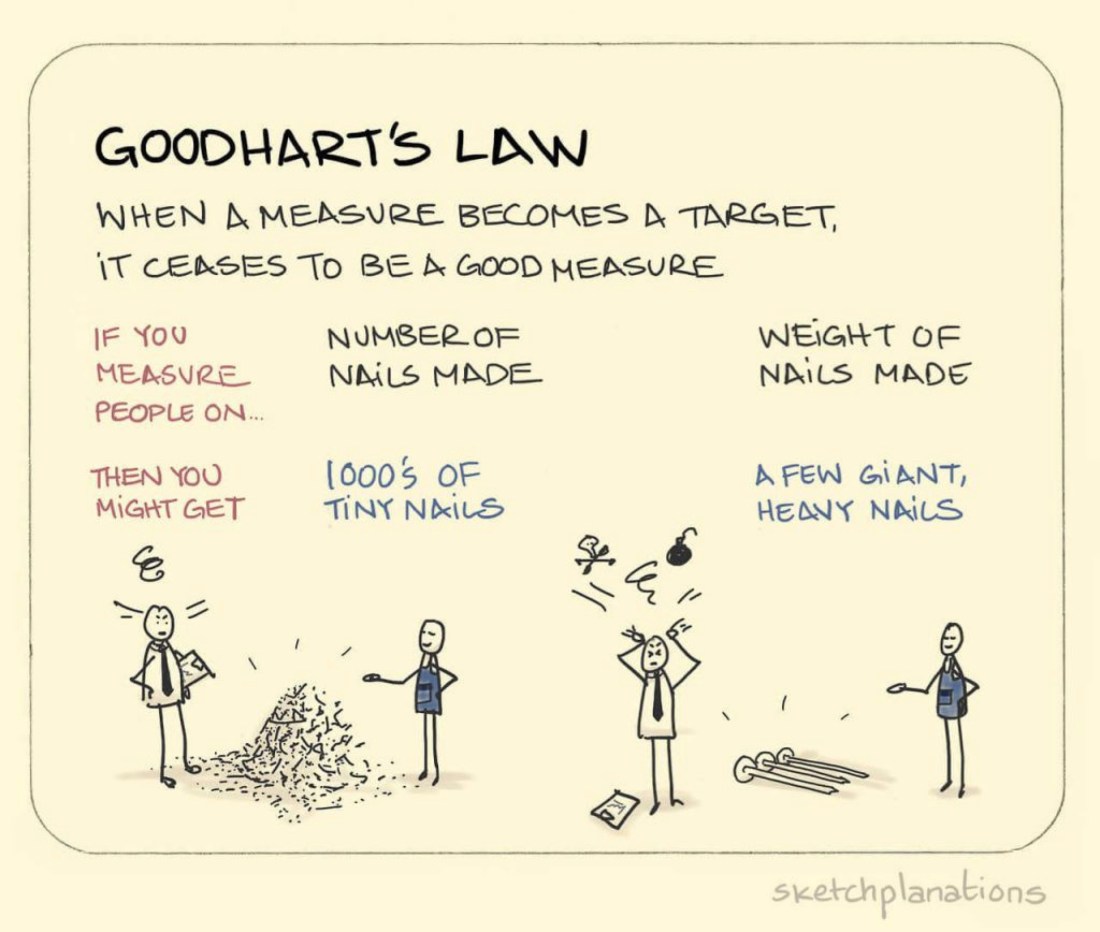
Goodhart’s Law is expressed simply as: “When a measure becomes a target, it ceases to be a good measure.” In other words, when we set one specific goal, people will tend to optimize for that objective regardless of the consequences.

Another way of stating Goodhart’s law – be careful what you measure because your employees are going to make it happen.

Below is a good illustration of this.

Goodharts

Some more interesting examples of Goodhart’s Law include:

  1. 雍正王朝 movie:When the emperor wants to get rid of the government’s deficit, the local officials borrowed money from the banks to solve the deficit problem, basically kicking the ball down the road, but solving the problem at hand, as directed by the Emperor.
  2. Cashier of the month as measured by speed of the scanning items: They will skip the hard-to-scan items, i.e., giving them to the customers for free, so that they are not slowed down.